
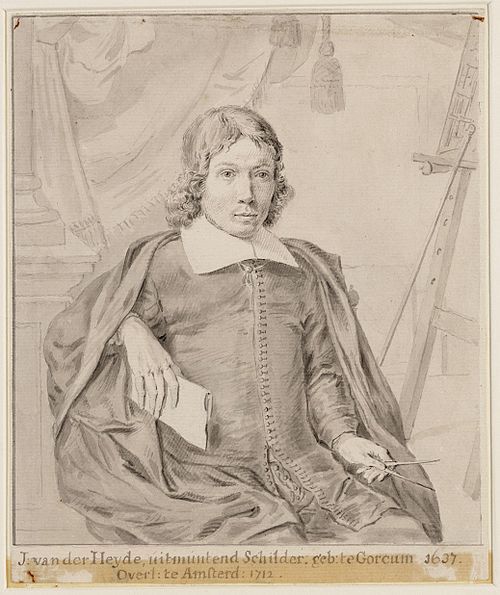
Jan van der Heyden (1637–1712): Jan van der Heyden was a master painter of the Dutch Golden Age (Baroque era), renowned for his exquisitely detailed cityscapes, or vedute. Born in Gorinchem, he trained as a glass painter but rose to fame in Amsterdam, specializing in architectural painting, which features buildings and street scenes. Unlike many of his contemporaries, he was also a celebrated inventor and engineer, devising a revolutionary street lighting system and improving the fire engine—a civic passion that may explain the meticulous, almost map-like precision of his art. His style is characterized by phenomenal technical virtuosity, capturing the texture of every brick and leaf, often bathed in a clear, luminous light. He is also considered a forerunner of the architectural capriccio, creating imaginary, highly detailed town views by combining real and fantastical elements. Stitching one of Van der Heyden's pieces is an act of meditative precision, transforming fine details into a textural masterpiece. It allows you to feel the quiet grandeur of 17th-century European city life, capturing the order, light, and history of the era, one faithful stitch at a time.
|
22+ Years
Designing Patterns
|
Satisfaction
Guaranteed
|
Family-Owned
Since 2003
|
Loved by Stitchers
Worldwide
|