
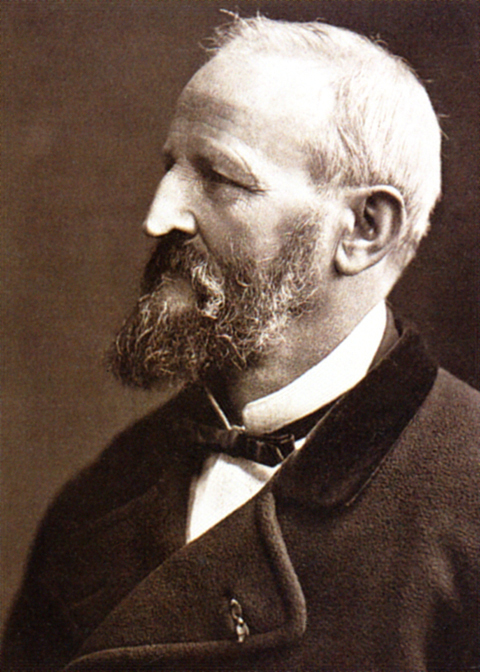
Karl Bodmer — Swiss frontier artist and Barbizon painter whose watercolors of Native American life along the Missouri River remain an irreplaceable historical record, adapted into counted cross stitch patterns by Sunrays Creations.
Karl Bodmer was twenty-three years old and relatively unknown when a German aristocrat named Prince Maximilian zu Wied-Neuwied hired him for what would become one of the most important artistic expeditions in American history. Born in Zürich in 1809 into a family with deep artistic connections — his uncle was a prominent engraver who had studied under Heinrich Füssli — Bodmer had spent his early years mastering watercolor, engraving, and printmaking with a precision that set him apart from his peers. By the time Prince Maximilian found him in Koblenz, he had already built a small reputation for his detailed watercolors of the Rhine, Mosel, and Lahn rivers. But nothing in those quiet European landscapes could have prepared him for what awaited across the Atlantic. On 17 May 1832, Bodmer, Prince Maximilian, and their party sailed for North America — and the young Swiss artist was about to change history.
What followed was two years of extraordinary work along the Missouri River, deep into territory that very few Europeans had ever seen. Bodmer painted with the sharp eye of a trained naturalist and the sensitivity of a true artist — capturing the faces, regalia, ceremonies, and landscapes of the Omaha, Mandan, Hidatsa, Blackfoot, and dozens of other Plains nations with a respect and accuracy that nobody before him had achieved. Prince Maximilian wrote that Bodmer was "a lively, very good man... in diligence he is never lacking." The 81 aquatints that came from this expedition illustrated Travels in the Interior of North America, published in 1839, and became the most accurate visual record of Plains Indian life ever produced. The tragic footnote — just three years after Bodmer left, a catastrophic smallpox epidemic virtually wiped out the Mandan people he had so carefully documented, making his watercolors an irreplaceable window into a world that no longer existed. Back in Europe, Bodmer settled in Barbizon, France, joined that celebrated school of landscape painters, and lived out his days painting forests and animals — a quiet second chapter after one of the most remarkable first acts in art history.
For the cross stitcher, Bodmer's work offers something truly unique — images that carry both artistic beauty and profound historical weight. His portraits of Native Americans are remarkable for their precise detail in facial features, elaborate headdresses, beadwork, and ceremonial regalia, which translates into incredibly satisfying and intricate stitch work. His landscapes of the Missouri River and the Great Plains have a luminous, wide-open quality that gives finished pieces a wonderful sense of space and atmosphere. Because his compositions often feature strong, detailed central figures against softly rendered natural backgrounds, you get a very rewarding contrast between careful close work and broader background stitching. A magnetic needle minder is a handy companion when working through the intricate detail in his portrait pieces. Only full cross stitches are used in our patterns. No blended colors are used. Instead, we use a variety of solid colors to achieve a more realistic effect. Our charts are in black and white only.
Prints & Books on Amazon
Our Bodmer cross stitch patterns bring his frontier watercolors to life one stitch at a time — but if his vivid portraits and Missouri River landscapes have you wanting one on your wall, you are in wonderful company. Browse his most celebrated works on Amazon.
Native American portraits print Missouri River landscape print Travels in the Interior of North AmericaFurther Reading & Historical Context
The largest collection of Bodmer's original watercolors and prints is held at the Joslyn Art Museum in Omaha, Nebraska. The Metropolitan Museum of Art in New York also holds significant works and organized a landmark exhibition of his Native American portraits.
Joslyn Art Museum, Omaha Metropolitan Museum of ArtAffiliate Disclosure
Sunrays Creations is a participant in the Amazon Services LLC Associates Program, an affiliate advertising program designed to provide a means for sites to earn advertising fees by linking to Amazon.com. Some links in this post are affiliate links — if you click through and make a purchase, we earn a small commission at no extra cost to you. We only recommend products we genuinely use and love. Thank you for supporting Sunrays Creations!
|
22+ Years
Designing Patterns
|
Satisfaction
Guaranteed
|
Family-Owned
Since 2003
|
Loved by Stitchers
Worldwide
|