
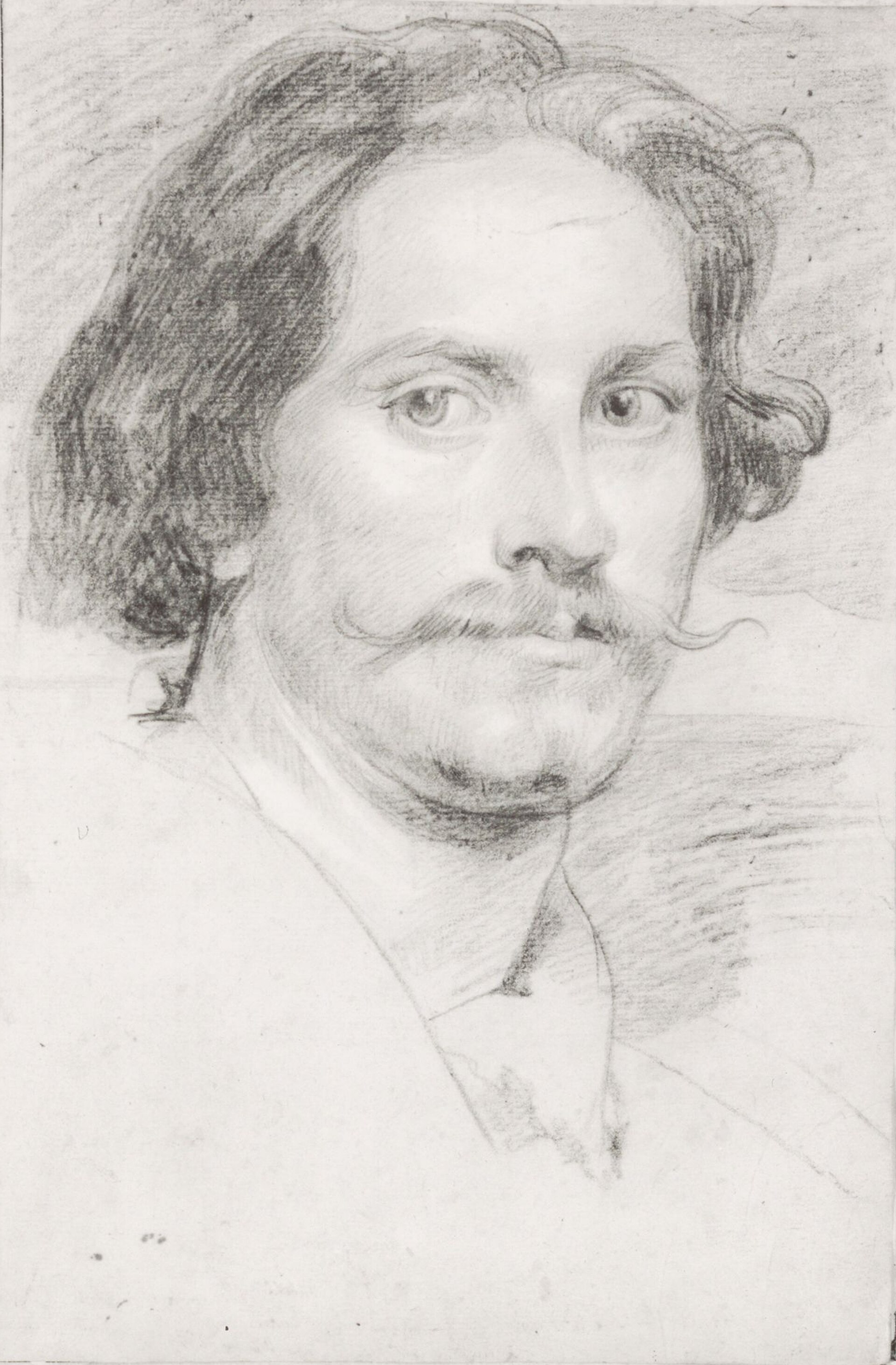
Jan Boeckhorst — Flemish Baroque painter known as Lange Jan, active in Antwerp within the circle of Rubens and Van Dyck. Portrait by Abraham van Diepenbeeck — Public Domain.
Jan Boeckhorst (c. 1604–1668) began his journey far from the bustling studios of Antwerp, born into a prominent family in Münster. A former Jesuit novice, he did not turn to painting until his early twenties, moving to Antwerp around 1626 to study the craft. Standing remarkably tall, he earned the nickname “Lange Jan” (Tall John) among his peers. By 1633, he was recognized as a master in the Guild of Saint Luke, having refined a style that blended the robust energy of the Flemish tradition with a sophisticated, lyrical grace. His early years were shaped by the immense influence of Peter Paul Rubens, whose studio became the center of Boeckhorst’s professional world.
As a trusted collaborator, Boeckhorst played a vital role in the production of some of the seventeenth century’s most significant commissions. He worked alongside Anthony van Dyck and contributed to the elaborate decorations for the Joyous Entry of Cardinal-Infante Ferdinand in 1635. His ability to adapt his brushwork to match the masters made him indispensable; after Rubens’ death in 1640, Boeckhorst was tasked with finishing several of the master’s incomplete canvases. This period saw him developing a penchant for rich, emotive color shifts and complex figurative arrangements. You can find Jan Boeckhorst Flemish Baroque painting prints on Amazon to see these legendary collaborations in fine detail.
Following a transformative trip to Italy, where he was influenced by the Venetian school’s use of light, Boeckhorst returned to Antwerp to produce his most celebrated independent works. He became a sought-after painter of altarpieces for churches across Flanders and a designer of exquisite tapestries. His legacy is defined by a unique warmth in his portraits and a dramatic flair in his mythological scenes, such as those depicting Apollo or the life of Achilles. Today, his works are preserved in prestigious institutions including the Kunsthistorisches Museum in Vienna, the Museum of Fine Arts in Ghent, and the National Museum in Warsaw. He remained a central figure in the Antwerp art scene until his death in 1668, leaving behind a massive collection of art that testified to his lifelong devotion to the Baroque aesthetic.
For the modern needleworker, an atmospheric fiber art adaptation of a Boeckhorst painting offers an immersive artisan journey. His designs are characterized by managing complex color shifts and a soft, painterly glow that translates beautifully into needlework. Whether it is the earthy tones of his genre scenes or the shimmering light of his allegories, these compositions provide a sophisticated challenge for those who appreciate the nuances of the Rubens circle. A high-quality DMC embroidery floss set in rich Baroque colors will help capture the depth of his palette. Only full cross stitches are used in our patterns. No blended colors are used. Instead, we use a variety of solid colors to achieve a more realistic effect. Our charts are in black and white only.
Prints & Books on Amazon
Bring a piece of Antwerp art history into your studio by browsing these Boeckhorst collections and reference prints.
Jan Boeckhorst art prints Flemish Baroque mythology prints Rubens workshop booksFurther Reading & Historical Context
Boeckhorst’s masterpieces are currently held at the Kunsthistorisches Museum, the Rubenshuis in Antwerp, and the Museum of Fine Arts in Ghent.
Wikipedia Kunsthistorisches Museum Artvee Artist ArchiveAffiliate Disclosure
Sunrays Creations is a participant in the Amazon Services LLC Associates Program, an affiliate advertising program designed to provide a means for sites to earn advertising fees by linking to Amazon.com. Some links in this post are affiliate links — if you click through and make a purchase, we earn a small commission at no extra cost to you. We only recommend products we genuinely use and love. Thank you for supporting Sunrays Creations!