
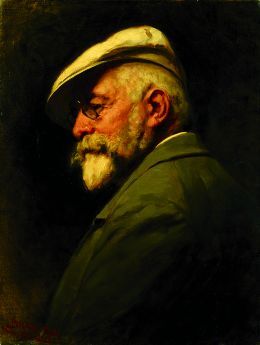
Gyula Benczúr was the undisputed titan of Hungarian academic art during the late 19th century, a painter whose brush defined the national identity of an empire. Born in Nyíregyháza, he rose to international prominence after winning a prestigious national competition with his masterpiece, "The Baptism of Vajk." His talent caught the eye of the legendary "mad" King Ludwig II of Bavaria, who commissioned him for grand Rococo-style projects, but Benczúr’s heart remained with the sweeping historical narratives of his homeland. As a favorite of the Hungarian upper class and the Habsburg court, he painted iconic portraits of Empress Elisabeth (Sissi) and King Franz Joseph I. His career was a whirlwind of gold medals and royal favor, culminating in his role as the director of the Master School of Art in Budapest, where he mentored a new generation of European painters. His work is a lush blend of dramatic lighting and historical grandeur, transitioning from the strict academicism of Munich to a more vibrant, light-filled realism.
Stitching a Benczúr design is like being invited to a royal gala. His work is famous for its opulent textures—think heavy velvets, shimmering silks, and the glint of imperial jewels—which make for an incredible "thread painting" experience. You’ll find yourself navigating a rich, sophisticated palette that requires a keen eye for color blending, especially in his grand historical scenes, where the interplay of shadow and light creates a sense of epic drama. For the dedicated stitcher, these designs are high-coverage and deeply rewarding, offering the chance to recreate the intricate details of 19th-century court life. Be prepared for some strategic confetti in the ornate backgrounds and medals, but the final result is a masterpiece that is truly stash-worthy.
The emotional reward of a Benczúr project lies in its sheer scale and dignity. Whether you are working on a tender portrait of a noblewoman or a monumental battle scene, the sense of history is palpable with every pull of the needle. To do justice to his academic precision, gridding your 14-count Aida or linen is a must, ensuring those regal postures and architectural details remain perfectly aligned. As you manage your tension through the sweeping folds of a royal robe, you aren't just stitching; you're preserving the legacy of a man who captured the soul of Hungary’s "Golden Age." It’s a hoop-ready journey for the stitcher who wants their work to feel like a museum-quality heirloom.
Further Reading & Historical Context: To explore his massive historical frescoes and portraits of the Hungarian royalty, visit the Hungarian National Gallery. You can also find more about his international influence and academic training through the archives at Britannica.