
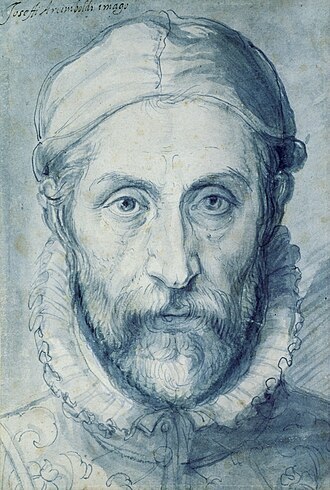
Giuseppe Arcimboldo (1526–1593) was one of the most imaginative and eccentric masters of the Late Renaissance and Mannerist periods. A favorite of the Habsburg court, he enjoyed the dedicated patronage of Emperors Ferdinand I, Maximilian II, and Rudolf II in Vienna and Prague. Arcimboldo is world-renowned for his "composite heads"—ingenious portraits where the facial features are composed entirely of objects like fruits, vegetables, flowers, fish, or books. His most famous cycles, The Four Seasons and The Four Elements, represent a sophisticated fusion of botanical precision and surrealist wit. His style, often classified as Mannerist Grotesque, was not merely for amusement but was deeply symbolic, reflecting the Emperor’s harmony over the microcosm of nature. For the cross stitcher, an Arcimboldo design is a vibrant explosion of color and texture. Recreating his work in thread is a playful and intellectually stimulating project; each "eye" made of a cherry or "nose" made of a pear offers a unique opportunity to blend diverse shades, resulting in a conversational masterpiece that is as much a work of science as it is art.